

Camellia sasanqua ‘Hana Jiman’ – Multi Stems
£1,295.00
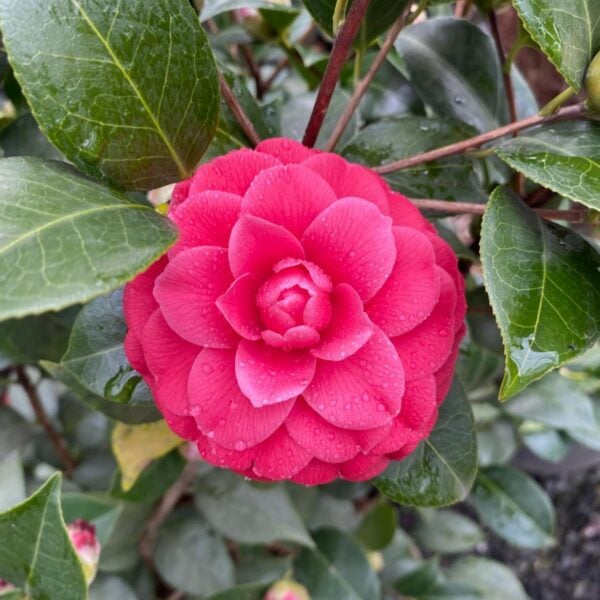
Camellia sasanqua ‘Hana Jiman’ at Architectural Plants is evergreen and hardy. A mid sized camellia to 2m x 1.5m, producing semi-double, lightly scented, pink-edged white flowers with a showy yellow central boss in the autumn. Best in a position sheltered from the cold east and north winds in dappled shade, though happy in full sun once established. They need a rich acid soil, moist but well drained. Summer watering will initiate development of flower buds. Propagated by cuttings.
This is a standout Camellia, indeed, the name ‘Hana Jiman’ translates as ‘proud of its flower.’ As part of the Camellia sasanqua family, it is a wonderful addition to the autumn garden, since its flowering season is from late autumn into the winter.
We first saw the beautiful wild Camellia sasanqua here in the UK when it was introduced from southern Japan in 1896, but had to wait nearly another 50 years before the arrival of Camellia sasanqua ‘Hana Jiman’.
Growing to around 3m in height, this is a large, upright shrub or a small tree, with a spread of 2m. It is evergreen and hardy, and carries dark green, glossy, leathery leaves, which are narrowly oval and lightly toothed. The flowers are white and semi double, but with a strong pink blush to the edges, all set off by the prominent central boss of yellow stamens. Rather than the whole bloom falling after flowering, this beautiful plant charmingly and neatly sheds its petals one by one.
Because it is autumn flowering it is worth being particularly careful about protection from the cold drying winds and making sure that Camellia sasanqua ‘Hana Jiman’ is planted in a spot away from the rising sun which could cause damage and browning to frozen petals early in the morning. A woodland edge position, or a spot with dappled shade is ideal preferably if there is a fertile, acidic, humus rich soil that is moist-but-well-drained. Supplementary watering may be advisable in a dry summer as too dry conditions will inhibit production of flower buds.
It is a useful plant for shady borders and mixed planting, and there are some indications that it is said to be resistant to deer, possibly because the leaves contain caffeine and are leathery and unpalatable.
IMPORTANT NOTE:
Photos represent the plants at their different stages. Your plant may arrive with new/loose roots, having been recently pruned or cut to enhance it's growth.
Additional Information |
|
|---|---|
| Size | |