
Acer japonicum ‘Aconitifolium’
Original price was: £695.00.£556.00Current price is: £556.00. incl. VAT
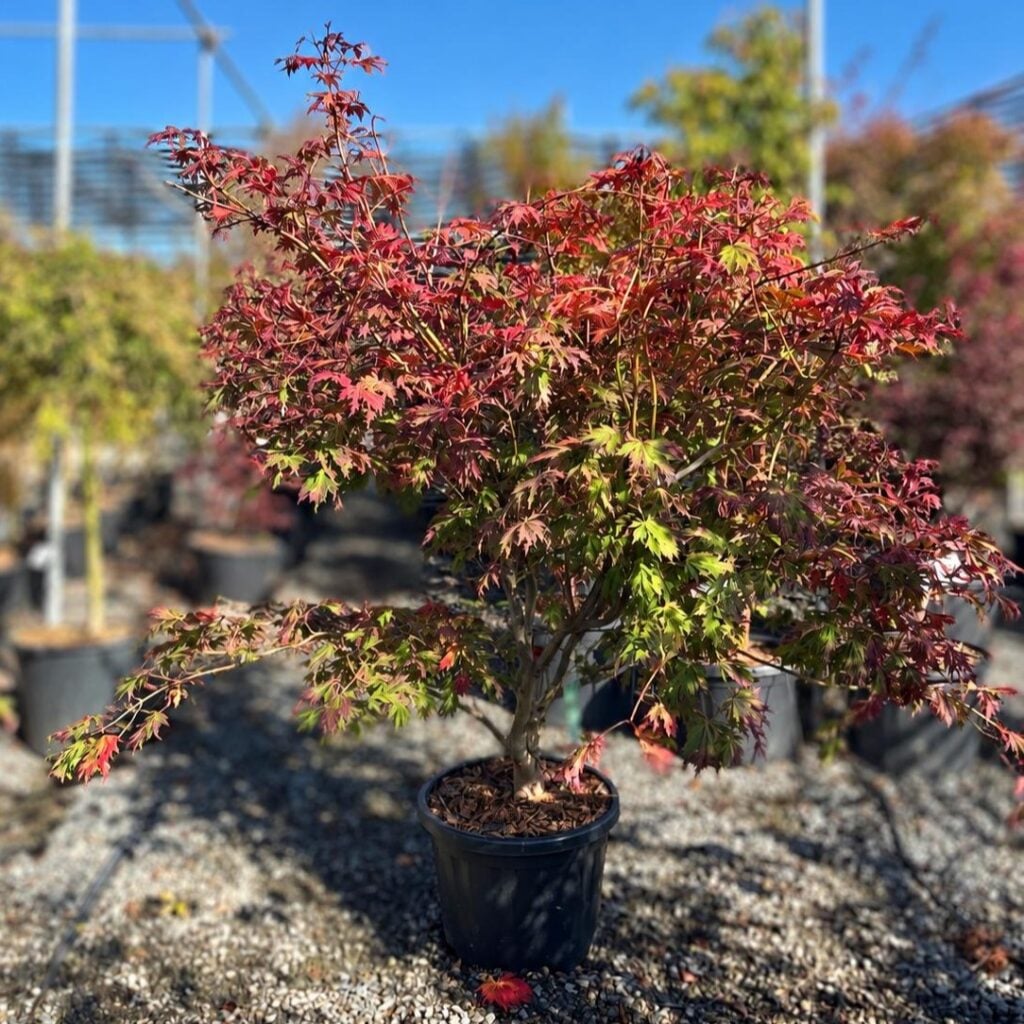
Acer japonicum ‘Aconitifolium’ at Architectural Plants is a slow growing small tree with green leaves and a distinctive spreading habit followed by a domed shape in maturity. Bright red autumn colour. Can reach up to 30ft after 50 years.
Best grown with their feet in the shade and head in the sun in well drained, moist, neutral to acid soil, protected from cold winds. Prune lightly for health but never when the sap is rising in the spring. Produced by cuttings/grafted.
Such a lovely Japanese cultivar has understandably been popular since it was first introduced to the UK in 1888. This is a strong and sturdy tree that over 20 or so years grows slowly to 7 or 8m in height, with a beautifully rounded crown.
The leaves are large and could be as much as 17cm in length and 14cm wide, but they are so divided, and so frilled and lacy that they have a fernlike appearance. It is their perceived resemblance to Monkshood or aconite, that has given them their most popular common name.
During the spring and summer, the leaves are a mid-green and it is their pretty shape that gives the tree its charm. The flowers are a beautiful coral red, followed by the clusters of winged seeds (samaras), which begin red before ripening to brown. It is in the autumn that the glory of the Acer japonicum ‘Aconitifolium’ is fully revealed as the foliage takes on the most intense reds and scarlets for an often long-lasting show.
Second only to the ‘palmatum’ varieties, Acer japonicum figures prominently in the list of Acer cultivars, and Acer japonicum ‘Aconitifolium’ is a particularly desirable form. Best grown in well drained, moist, neutral to acid soil in light shade and positioned so that it has protection from cold and drying winds in early spring.
Acers in general are widespread across the Japanese Islands and occur over a huge range of soils and conditions. They tend not to be gross feeders and the use of a balanced rose fertiliser or slow-release pellets applied lightly in spring seems to be sufficient. They have shallow and fibrous root balls so are pretty good in pots.
Acers can be pruned and it is better to start shaping the plant while young as the smaller the pruning wound the sooner it heals. Larger stems should be pruned when the trees are dormant well before the sap rises in the spring. Good hygiene of tools and equipment is always essential to avoid spread of disease.
IMPORTANT NOTE:
Photos represent the plants at their different stages. Your plant may arrive with new/loose roots, having been recently pruned or cut to enhance it's growth.
Additional Information |
|
|---|---|
| Size | |
| Plant Type | |