
Hippophae rhamnoides (Sea Buckthorn)
From £47.50 incl. VAT
Hippophae rhamnoides is the ultimate coastal plant! This semi deciduous, hardy, suckering plant has deep roots and is drought and salt tolerant.

Hardiness level Green
I knew this plant from childhood trips to the seaside. Hippophae rhamnoides is a silver leafed barrier of tall, thorny shrubs growing in the sandy dunes a little way back from the sea. It was particularly noticeable in the autumn when the dark stems were covered with dense clusters of the brightest orange or yellow berries. I knew it as Sea Buckthorn, but I knew little else about it until some appeared near our lake here at Architectural Plants.
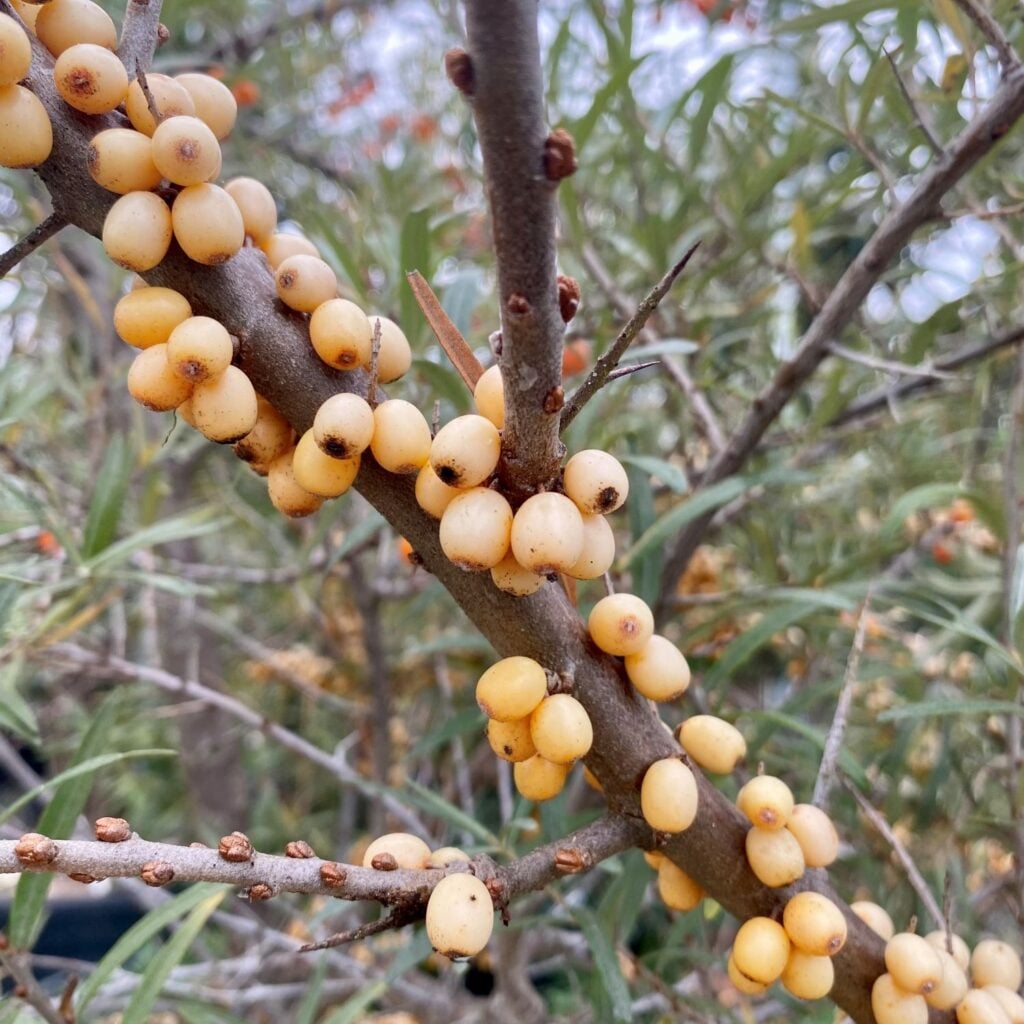
Take a walk around the lake at our nursery, and there on the eastern bank are five mid-sized shrubs with dark brown bark and slender silver-grey leaves which Colin has thinned, pruned and shaped into lovely plants. If you are with us in the spring, they will have tiny, scented yellow flowers, and in the autumn, the female plants carry massed ranks of orange or yellow berries. This is Hippophae rhamnoides.
It’s a survivor of a plant that is native to Eurasia so is exceedingly tolerant of all sorts of conditions. A deciduous plant for full sun, though initially may need watering, once established it is drought resistant. It can grow up to 6m in height as a small tree or as a large shrub that is hardy anywhere whether planted inland or right by the sea as long as the soil is free draining. We have heavy clay soil on our nursery, which is why Colin has planted them on the bank which gives them better drainage. Position it in full sun and prune it as required. It is wind pollinated so both male and female plants would be required for the production of berries.
Harvesting of these orange or red fruits is incredibly labour intensive requiring a delicate touch as the berries are soft, thin-skinned, don’t separate easily from the plant and the branches are thorny! In commercial orchard production, a successful system is being developed that involves cutting off the fruiting branch, freezing it, and then shaking off the frozen berries, which achieves both pruning and harvesting in a single process. The berries have high vitamin and mineral content and are used in traditional medicine and cosmetics. In the kitchen the fruit is used for oil, juice and jam, and the dried, ground leaves are used to make tea.
I love the fact that the name is derived from ancient Greek with ‘Hippo’ meaning horse, and ‘phae’ meaning shiny since they used the plant as animal fodder, yielding me visions of glossy coated animals prancing about. These days, the plant and the residues from fruit pressings are still used as animal fodder and the results for both animal health and weight are excellent.
Hippophae rhamnoides suckers freely, has a deep root system and is a nitrogen fixer. It is widely planted as a shelterbelt, used for stabilising sand dunes, reclaiming saline soils and regenerating impoverished ones. It’s a bit of a wonder-shrub that in the garden would make a beautiful specimen tree or a wonderful hedge.
IMPORTANT NOTE:
Photos represent the plants at their different stages. Your plant may arrive with new/loose roots, having been recently pruned or cut to enhance it's growth.
Additional Information |
|
|---|---|
| Size | 10L (H1.2-1.3m), 130L (H1.5-3m, W2-2.3m), 20L (H1.6-1.8m, W50-60cm) |
| Plant Type | |
| Continent of Origin | |
| Features | |
| Light | |
| Flower Colour | |
| Situation | Coastal, Exposed (To wind and sun), Mild City Gardens, Seaside, Sheltered Garden |
| Soil Type | |
| Hardiness | |
FAQs
HOW FAST DOES HIPPOPHAE RHAMNOIDES GROW?
20cm-30cm annually, depending on conditions.
HOW DO YOU TAKE CARE OF HIPPOPHAE RHAMNOIDES?
Plant in full sun on well drained soil. Water as needed until established.
HOW TALL DOES HIPPOPHAE RHAMNOIDES GROW?
5m over 10 years.
DOES HIPPOPHAE RHAMNOIDES PREFER SUN OR SHADE?
Full sun.
IS HIPPOPHAE RHAMNOIDES AN INDOOR OR OUTDOOR PLANT?
Outdoor.
IS HIPPOPHAE RHAMNOIDES SUITABLE FOR HEDGING?
Yes.
CAN HIPPOPHAE RHAMNOIDES BE GROWN IN POTS OR CONTAINERS?
No.